


• Food minister says provinces must maintain strategic wheat reserves in line with population
• Senate panel informed strict monitoring prevented crop failures
• Lawmakers concerned over research gap, point out lack of efforts to boost donkey farming
ISLAMABAD: The federal government has asked provincial governments to fully implement the interim national wheat policy 2025-26 within their respective jurisdictions to safeguard the rights of wheat farmers and flour consumers.
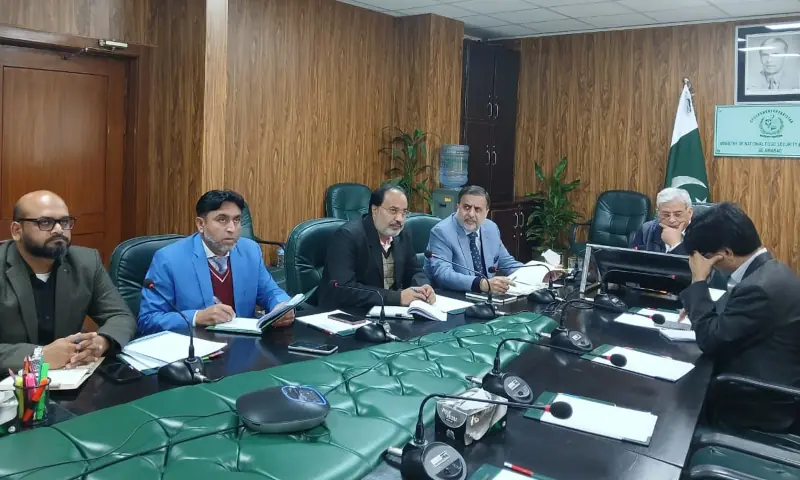
The advice came at the conclusion of the first meeting of the National Wheat Oversight Committee formed under the interim wheat policy, chaired by Minister for National Food Security and Research Rana Tanveer Hussain, in Islamabad on Monday.
At the same time, the minister emphasised that all provincial governments must maintain strategic wheat reserves in accordance with their population requirements to ensure food security. It may be noted that the interim policy remains under wraps, but a few weeks ago, the government shared a new roadmap for wheat procurement.
In September this year, the federal government unveiled the ‘National Wheat Policy and Wheat Management Strategy’ for 2025-26 to serve as a long-term plan to ensure food security, safeguard farmers’ livelihoods, protect consumers and build resilience against market disruptions and climate-induced emergencies. At the time, the food minister had said the wheat policy would be finalised and adopted after comprehensive consultations with all stakeholders.
Food minister says provinces must maintain strategic wheat reserves in line with population
During the meeting on Monday, Mr Tanveer highlighted the strategic importance of wheat in meeting the country’s food requirements and emphasised the need for increasing wheat cultivation to ensure national food security. Detailed deliberations were held on the procurement mechanism for the upcoming wheat crop in line with the policy’s objectives.
He also stressed the importance of including the private sector in the wheat value chain to create new business opportunities and generate employment, particularly for the youth. The meeting was attended by provincial and regional secretaries of food and agriculture, along with senior officials from relevant departments.
Senators briefed on crop monitoring
Separately, the Senate Standing Committee on National Food Security and Research was informed on Monday that due to strict monitoring mechanisms, Pakistan did not face any major wheat or rice crop failure caused by diseases, such as yellow rust.
The committee reviewed the latest research undertaken by scientists at the Pakistan Agricultural Research Council and the National Agricultural Research Centre regarding newly evolved seed varieties and assessed the progress of the Green Pakistan Initiative (GPI), with particular emphasis on the livestock sector.
About 1,500 wheat lines and 500 rice lines are regularly monitored under the Crop Diseases Research Institute (CDRI) to prevent the spread of crop diseases under the mechanism developed by the Pakistan Agricultural Research Council and the National Agricultural Research Centre. The standing committee was briefed about these initiatives during its visit to the National Agriculture Research Centre (NARC).
At the research centre, the committee members were apprised of the functioning of various scientific laboratories and research institutions. A comprehensive briefing was given on the functions, mandate, and working of PARC and NARC.
The committee visited the NARC and received briefings on the functioning of various scientific laboratories and research institutions. During the visit to the Land Resource Research Institute, the committee was briefed on bio-fertilisers and training initiatives being undertaken by NARC to enable farmers to produce bio-fertilisers independently.
The committee appreciated the wheat and pulses speed breeding facilities but expressed concern over the widening research gap due to climate change. Committee Chairman Senator Syed Masroor Ahsan directed PARC to focus on promoting smart agricultural practices and developing climate-resilient seed varieties.
Emphasising the promotion of smart agriculture, fisheries development, and bridging the gap between research and farmers, the committee chairman directed the authorities to intensify efforts towards national development and economic strengthening through agricultural and livestock research and development. Mr Ahsan further stressed that each and every media source should be used to create awareness among the farmers so that they may benefit from the latest research.
The committee highlighted that although agriculture was a devolved subject after the 18th Amendment, effective coordination between the federation and provinces in the agriculture and livestock sectors was essential.
The committee also received a comprehensive briefing on the GPI, particularly focusing on the livestock sector. Members were briefed on initiatives, including animal tagging and the establishment of model animal markets. It was informed that Pakistan was the “third-largest milk producer” in the world.The committee raised questions regarding donkey farming initiatives for meat and skin exports and pointed out the lack of organised efforts to develop this sector.
Published in Dawn, December 16th, 2025


